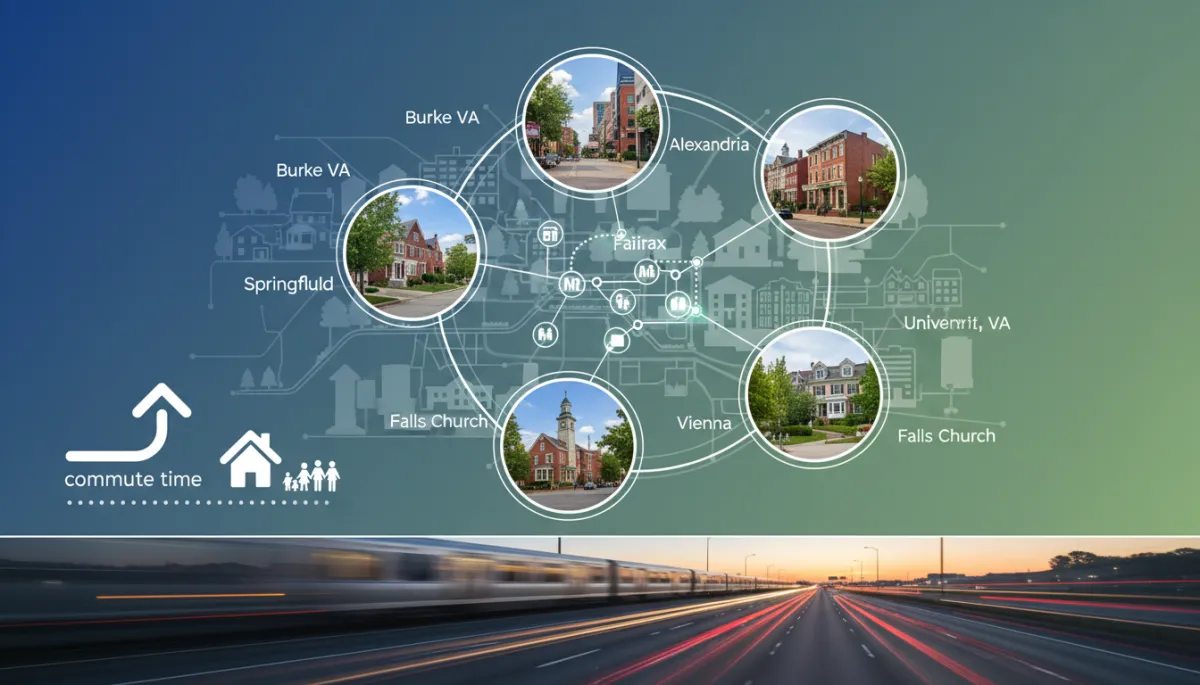
Top Commuter-Friendly Suburbs Near Washington, DC
Real Estate, Washington DC Suburbs, Commuter-Friendly Neighborhoods
What Are the Best Commuter-Friendly Neighborhoods Near Washington, DC?
For many Northern Virginia homebuyers, the question is not just “Which house do we love?” but “What will our commute feel like, day after day?” In the Washington, DC region—where average trips can hover around 50 minutes via transit—choosing the right neighborhood can dramatically change your quality of life. The Mike Webb Team works with families every week who are balancing commute times, schools, budgets, and lifestyle, and this guide focuses on six consistently strong commuter-friendly options: Burke, Springfield, Alexandria, Fairfax, Vienna, and Falls Church.
What Makes a Neighborhood Truly Commuter-Friendly?
In the DC metro area, “commuter-friendly” is about more than just distance on a map. It is a combination of access to Metro stations, highway access, multiple commuting options, and how those elements line up with your daily routine and personal priorities. Even as telework remains common, regional data still shows long average trip times, so shaving 10–20 minutes off each direction can add up to hours of your week returned to family, hobbies, or rest.
Metro access: Proximity to Metrorail, Virginia Railway Express (VRE), or reliable bus links to stations can allow you to avoid traffic and parking costs in the city. WMATA continues to invest in upgrades and service improvements across the system, which benefits many Northern Virginia commuters.
Highway connectivity: Easy access to I‑395, I‑495, I‑95, I‑66, and key arterials like the Fairfax County Parkway or Route 7 often determines whether a drive is manageable or exhausting, especially during peak hours.
Multiple commuting options: Neighborhoods that offer a mix of driving routes, bus lines, Metro, VRE, and even bike trails give you flexibility as your job, schedule, or regional traffic patterns change over time.
💡 From The Mike Webb Team: When we evaluate homes with clients, we always look at at least two realistic commute scenarios—best case and typical rush hour—before they make an offer.
Burke: Suburban Calm with Rail and Road Flexibility
Burke is a favorite for buyers who want a quiet, established suburban feel without giving up commute options. It offers a strong mix of single-family homes and townhomes, mature trees, and well-regarded schools, making it a consistent contender for families planning to stay long term.
Rail options: The Virginia Railway Express (VRE) Burke Centre station provides a direct commuter rail link into Alexandria, Crystal City, and Union Station, ideal for those working downtown or near the Pentagon and who prefer a predictable schedule over highway traffic.
Highway access: While Burke does not sit directly on an interstate, it connects efficiently to the Fairfax County Parkway, which then links to I‑66, I‑95, and I‑495. This layered network helps drivers adjust routes when congestion builds in one corridor.
Bus and park-and-ride: Fairfax Connector buses and park-and-ride options allow residents to connect to Metro stations and employment centers without driving the full distance themselves.
For buyers who value a quieter environment, access to parks and trails, and the ability to choose between VRE and car commuting, Burke often delivers an excellent balance of value and convenience.
Springfield: Highway Hub with Strong Transit Connections
Springfield is one of Northern Virginia’s key transportation hubs, particularly appealing to commuters who need to reach multiple parts of the region. The mix of older and newer neighborhoods, townhomes, and single-family homes offers options at several price points, which is valuable in a market where suburban demand remains strong.
Highway access: Springfield sits at the intersection of I‑95, I‑395, and the Capital Beltway (I‑495). For professionals who split time between DC, Tysons, Fort Belvoir, or points south, this central location can significantly cut down on backtracking and detours.
Metro access: The Franconia–Springfield Metro station (Blue Line) and VRE station provide a direct rail route into DC and Alexandria, along with extensive park-and-ride facilities and bus connections.
Multiple commuting options: Between HOV/Express Lanes on I‑95, Metro, VRE, and local bus services, Springfield residents can adjust their commute strategy as job locations or work schedules change.
📌 Key Takeaway: If your household has more than one commuter heading in different directions, Springfield’s central highway and transit access can be a powerful advantage.
Alexandria: Urban-Suburban Blend with Strong Metro Coverage
Alexandria offers a distinct mix of historic charm, waterfront living, and modern development, all with excellent transit connectivity. It appeals to buyers who want a shorter commute, walkable amenities, and a more urban-suburban feel than farther-out suburbs provide.
Metro stations: Multiple stations—such as King Street–Old Town, Braddock Road, Eisenhower Avenue, and Huntington—provide access to the Blue and Yellow lines. From many Alexandria neighborhoods, you can be in downtown DC in roughly 20–30 minutes via Metro under typical conditions, which is significantly shorter than many outer suburbs.
Highway access: I‑395 and the George Washington Parkway offer direct driving routes into DC, the Pentagon, and Arlington. For some buyers, especially those with hybrid schedules, the ability to choose between Metro and a short drive is a major benefit.
Local transit and walkability: Alexandria’s DASH bus system, bike lanes, and walkable corridors—especially in Old Town and Carlyle—support car-light living. This is attractive for homeowners who want to minimize daily driving without sacrificing neighborhood character.
While prices in Alexandria can be higher than in some farther-out suburbs, many buyers see the reduced commute time and lifestyle amenities as a worthwhile tradeoff, especially in a regional market where close-in suburbs continue to show resilience and steady demand.
Fairfax: Central Location and Diverse Housing Choices
Fairfax (including Fairfax City and nearby Fairfax County communities) is a well-established hub with a broad range of housing, strong schools, and access to major employment corridors. Recent market data has shown price growth in Fairfax City, reflecting its continued appeal among buyers who value both convenience and community feel.
Metro access: Nearby stations such as Vienna/Fairfax–GMU on the Orange Line and the Silver Line stations to the north provide rail access into DC and Arlington. Many Fairfax neighborhoods are a short drive or bus ride from these stations, with park-and-ride facilities easing the last mile.
Highways: Fairfax benefits from proximity to I‑66, Route 50, Route 29, and the Fairfax County Parkway, giving commuters several options to reach Tysons, Reston, Arlington, or downtown DC. The Transform 66 improvements, including express lanes, are designed to enhance reliability for drivers and transit users along this corridor.
Multiple commuting options: Fairfax Connector and Metrobus routes, along with park-and-ride lots, allow residents to combine driving with transit, which can be especially helpful when downtown parking costs or traffic volumes rise.

Easy access to Metro or VRE can turn a stressful drive into a predictable routine.
Vienna: Small-Town Charm with Direct Orange Line Access
Vienna is frequently cited as one of the most desirable Northern Virginia suburbs, thanks to its small-town main street, strong schools, and direct access to the Metro. For buyers who want a community-oriented feel without sacrificing a manageable commute, Vienna deserves a close look.
Metro station: The Vienna/Fairfax–GMU station at the western end of the Orange Line provides a straightforward rail route into Arlington and downtown DC. Park-and-ride lots and bus connections make it accessible from many surrounding neighborhoods.
Highway access: Proximity to I‑66 and Route 123 allows drivers to reach Tysons, Fairfax, and DC efficiently. For those commuting to Tysons or Arlington, Vienna can significantly reduce drive times compared with outer-ring suburbs.
Bike and trail options: The W&OD Trail runs through Vienna, offering a viable bike commute for some and a pleasant alternative for weekends or occasional car-free days.
Because of its reputation for schools and livability, Vienna can be competitive in terms of pricing and days on market, but buyers often find the investment worthwhile given the combination of lifestyle and commute benefits.
Falls Church: Close-In Convenience and Strong Regional Access
Falls Church—both the independent city and nearby areas in Fairfax County—offers some of the region’s most convenient access to DC, Arlington, and Tysons. Recent data shows that Falls Church has seen notable price growth, reflecting how strongly buyers value its combination of schools, location, and transit.
Metro stations: West Falls Church, East Falls Church, and nearby stations like West Falls Church VT–UVA on the Orange and Silver Lines provide quick rail access to DC and Tysons. Many neighborhoods are within a short drive, bike ride, or bus trip to these stations.
Highways: Falls Church is close to I‑66, Route 7, and the Capital Beltway, making it ideal for commuters who may split time between downtown DC, Tysons, and other suburban job centers.
Multiple commuting options: Shorter distances mean that driving, Metro, bus, biking, or even occasional rideshares can all be realistic options, giving residents flexibility as traffic patterns or work arrangements evolve.
💡 Pro Tip from The Mike Webb Team: In close-in areas like Falls Church, a slightly higher home price can be offset over time by lower commuting costs, reduced vehicle wear, and—most importantly—more time at home.
How Commute Time Shapes Real-Life Decisions: A Client Story
One recent couple we worked with—let’s call them Sarah and James—came to The Mike Webb Team focused almost entirely on square footage and school ratings. They were initially drawn to larger homes farther out, where their budget stretched comfortably. On paper, everything looked perfect.
When we started mapping their likely commute into downtown DC and Arlington, however, the picture changed. Their first-choice home would have required a drive of 60–75 minutes each way in typical traffic, with limited backup options if there were accidents or construction. We encouraged them to test the route during rush hour and compare it with a home in Springfield that was closer to both a Metro station and major highways.
After a week of trial commutes, they realized the difference was nearly one extra hour per day saved by choosing the more commuter-friendly option. That translated into time for dinner with their young children, evening walks, and less stress overall. They ultimately chose the Springfield home, even though it was slightly smaller, because the impact of commute time on their daily life became impossible to ignore.
“We thought we were buying a house,” Sarah later told us, “but what we were really buying was our weekday routine.”
Common Mistakes Buyers Make When Evaluating Commutes
Even experienced buyers can underestimate how much a commute will shape their satisfaction with a home. Here are some of the most frequent mistakes we see—and how to avoid them.
Relying on mapping apps at off-peak times: Checking a route at 10 a.m. on a Tuesday will not reflect true rush-hour conditions. Always test your commute during the times you are most likely to travel.
Ignoring backup options: A neighborhood with only one realistic route into the city can become frustrating when there is a major incident. Commuter-friendly areas usually offer several alternatives—Metro, VRE, express lanes, or different highways.
Underestimating door-to-door time: It is not just “drive to the station” or “time on the train.” Factor in parking, walking, transfers, and security lines if you work in high-security buildings or near federal facilities.
Focusing only on today’s job: The DC region’s job market can shift quickly. Choosing a neighborhood with multiple commuting options protects you if your next role is in a different corridor—Tysons instead of DC, for example, or National Landing instead of downtown.
Overlooking emotional impact: A long, stressful commute can affect sleep, family time, and even your willingness to socialize or exercise. Those “soft” factors often matter more than an extra bedroom or slightly larger yard.
⚠️ Warning: If a home only works for you when everything goes perfectly—no traffic, no delays, no schedule changes—it may not be the right fit for your real, everyday life.
Choosing the Right Neighborhood Based on Your Personal Priorities
There is no single “best” commuter-friendly neighborhood near Washington, DC. The right choice depends on what you value most—time, space, schools, budget, or walkability. The role of The Mike Webb Team is to help you weigh these factors clearly, so you can move forward with confidence rather than guesswork.
Step 1: Clarify Your Non-Negotiables
Start by listing what must be true for this move to feel successful. For many of our clients, that list includes:
Maximum acceptable door-to-door commute time (for example, 45 minutes each way)
Desired school boundaries or educational priorities
Budget range and type of home (townhome vs. single-family)
Preference for walkable amenities versus larger lot sizes
Step 2: Match Neighborhoods to Your Commute Profile
Once you know your non-negotiables, we can help you align them with specific neighborhoods:
If you prioritize the shortest possible commute into DC or Arlington: Focus on Alexandria and Falls Church, where Metro and highway proximity can significantly reduce daily travel time.
If you want more space with rail access: Burke and Springfield offer a balance of larger homes, VRE and Metro connectivity, and strong road networks.
If you value small-town feel plus Metro: Vienna and parts of Fairfax give you access to the Orange and Silver Lines, good schools, and a strong sense of community.
Step 3: Test Your Commute Before You Commit
Before you make an offer, we strongly recommend doing at least two trial runs from the neighborhood to your workplace:
One during your typical morning rush hour, using your preferred route or transit option.
One during your typical evening return, possibly using a backup route or alternate mode (for example, driving one day and taking Metro or VRE another).
Track the full door-to-door time, including walking, parking, and transfers. Then ask yourself honestly: “Can I do this four or five days a week for the next several years?” If the answer is no, it is better to adjust your search now than to feel trapped later.
Step 4: Balance Today’s Needs with Tomorrow’s Possibilities
The DC region’s job centers are increasingly dispersed—downtown DC, National Landing, Tysons, Reston, and beyond. Neighborhoods with strong Metro station access, highway access, and multiple commuting options tend to hold their value well because they serve a wide range of potential buyers and job locations. That can matter not only for your daily life, but also when it is time to sell and move forward.
💬 How We Can Help: The Mike Webb Team specializes in guiding homeowners and buyers through these tradeoffs with clear, data-informed advice—so you can maximize both your home’s long-term value and your day-to-day quality of life.
Moving Forward with Confidence in the DC Metro Market
The Washington, DC area remains one of the country’s most dynamic housing markets, with suburban communities in Northern Virginia continuing to attract buyers who want space, schools, and better commutes. While overall price growth is expected to be modest and inventory is gradually improving, close-in, commuter-friendly neighborhoods like Alexandria, Falls Church, Vienna, Fairfax, Springfield, and Burke continue to stand out for their blend of accessibility and livability.
Choosing the right neighborhood is ultimately about aligning your daily reality—your commute, your family’s schedule, your budget—with the long-term goals you have for your home and lifestyle. When you are ready to explore options, The Mike Webb Team is here to provide clear, trustworthy guidance, help you avoid common pitfalls, and ensure that the home you choose supports not just where you live, but how you live.
If you are considering a move to or within the Washington, DC area and want to understand which commuter-friendly neighborhoods best match your priorities, we would be glad to walk through the options with you—step by step, and at your pace.